See below for updates!
After a month or so of testing, I considered the LuciLed (Neopixel-based condenser substitute) sufficiently useful to spend the time creating a graphic interface using a Nextion 2.8 (NX3224T028) inch display. Programming Nextions takes a bit of getting used to… to say the very least (!). I had an old Nextion display in my Arduino Uno-based weather station which through the purchase of a commercial one, had been rendered obsolete. So, I cannibalized the old weather station and utilized its Arduino Uno and display. The effort I have put in should not be taken to suggest that a NeoPixel-based ‘condenser’ can replace a nice ‘glass’ one. A ‘glass condenser’ with an appropriate filter will produce darker backgrounds in dark-field, will produce much brighter illumination and has other advantages. However, the LuciLed’s versatility could be useful. You can for example, pretty much instantaneously switch from say oblique illumination from one side to another or from that to Rheinberg or circular oblique in any colour you could wish. There is also the opportunity to animate things such that the system automatically switches from one form, colour and direction of illumination to another. I have yet to implement such animation but it would be simple to do so.
Because it is a serial device, the wiring of the Nextion display, is very straight-forward. I used an Arduino shield to make the wiring a bit easier. Effectively there are just half-a-dozen connections to make; pins 0 and 1 (TX/RX) for serial comms to the Nextion, pin 6 as the Neopixel data line, then there is *independent* 5V power for the Neopixels the supply to which must share a ground with the supply for the Arduino. I use a lab-pack power supply for the NeoPixels because many ‘wall-wart’ supplies use buck-converters that will cause banding when taking pictures. I have incorporated a ~300uF capacitor across the supply lines to the NeoPixels and a 300R resistor in the data line near to the LEDs. Explanations for those components can be found on the web though I would add that everything works fine without them… but better safe than sorry?
There is not a lot that I could write that could not be better illustrated by some pictures and videos. I will place my C++ code on Github. Note that in the second video, I have made no attempt to refocus something that is necessary with achromatic lenses that limit but do not entirely overcome, chromatic abberation, nor have I made the necessary changes to the shutter speed or ISO. Thus, the background in the dark field examples are brighter than they appear through the microscope’s eyepieces and things are sometimes a little fuzzy. A better video when i have the time!
Update:
I have made an updated version of the LuciLED illuminator for condenserless microscopy. I recently restored an old Zeiss Universal that came with several phase objectives and I wanted to see if the NeoPixel ring lights would would work with them. For this reason and because the available travel on the Zeiss condenser-holder was limited, I constructed a two ring version of the original design. For low NA objectives the illuminator needs either a small ring or a larger one further from the slide. Thus, to cover objectives of different NA s two rings may sometimes be required. Also, to fit a NeoPixel ring to the phase ring in a particular objective, a larger ring may be necessary. The two rings I used along with the central illuminator, have a total of 57 LEDs, it isn’t convenient to control them on a one-by-one basis! Thus, I rewrote the code for the Nextion-based controller such that it can switch on the rings in quadrants or a whole ring at a time. I have found this to be a quick and very convenient way of controlling the illuminator. I found that the large ring (48mm OD – 36 LEDS) was a very good fit to the phase ring in my Ph3 objective. The smaller ring (27mm OD – 18 LEDS) also ‘fits’ but because it works closer to the slide, the width of the strip comprising the annulus is too wide and light-spill ruins the phase effect. I will find a way of posting the code for the controller but for now since as ever, a few pictures are worth a thousand words so see below:
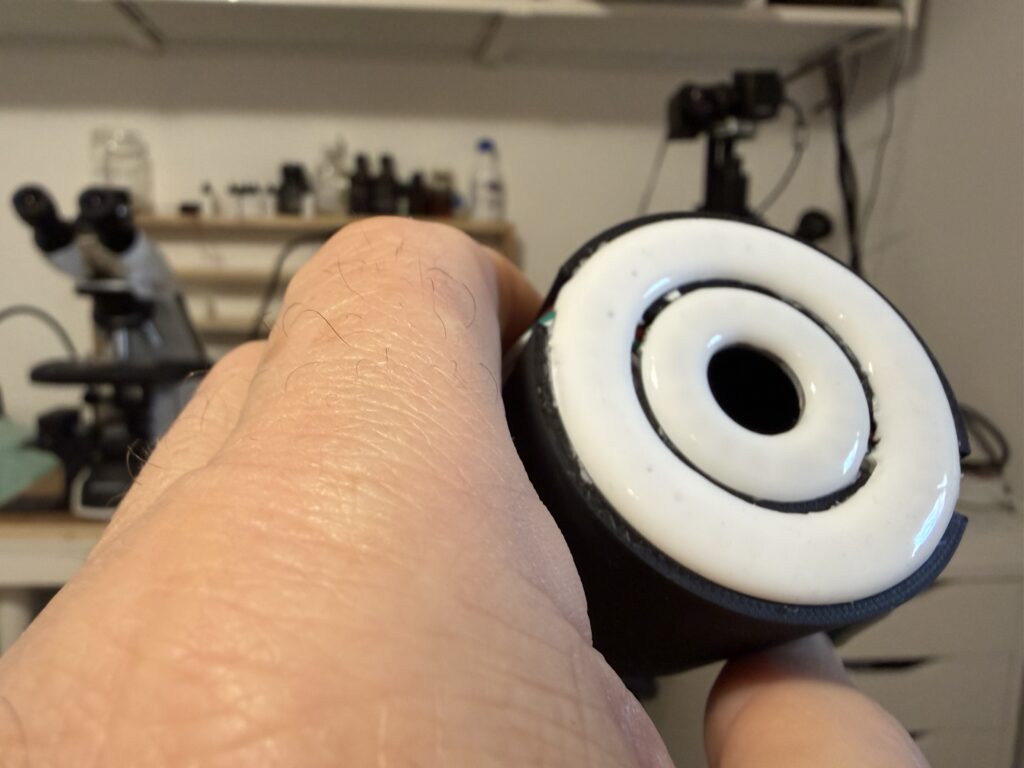
The two ring version that I constructed for the Zeiss Universal.
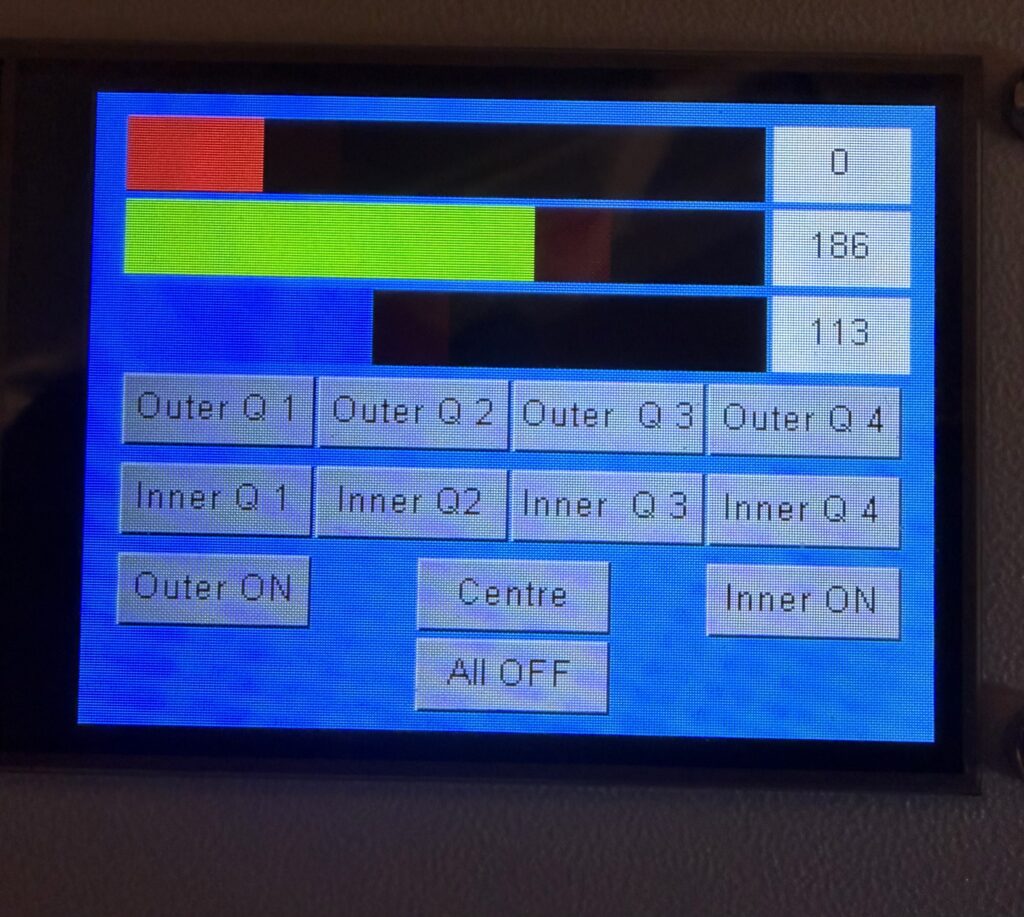
The Nextion interface for the 2-ring LuciLED illuminator – my picture caught the red slider before it had updated!
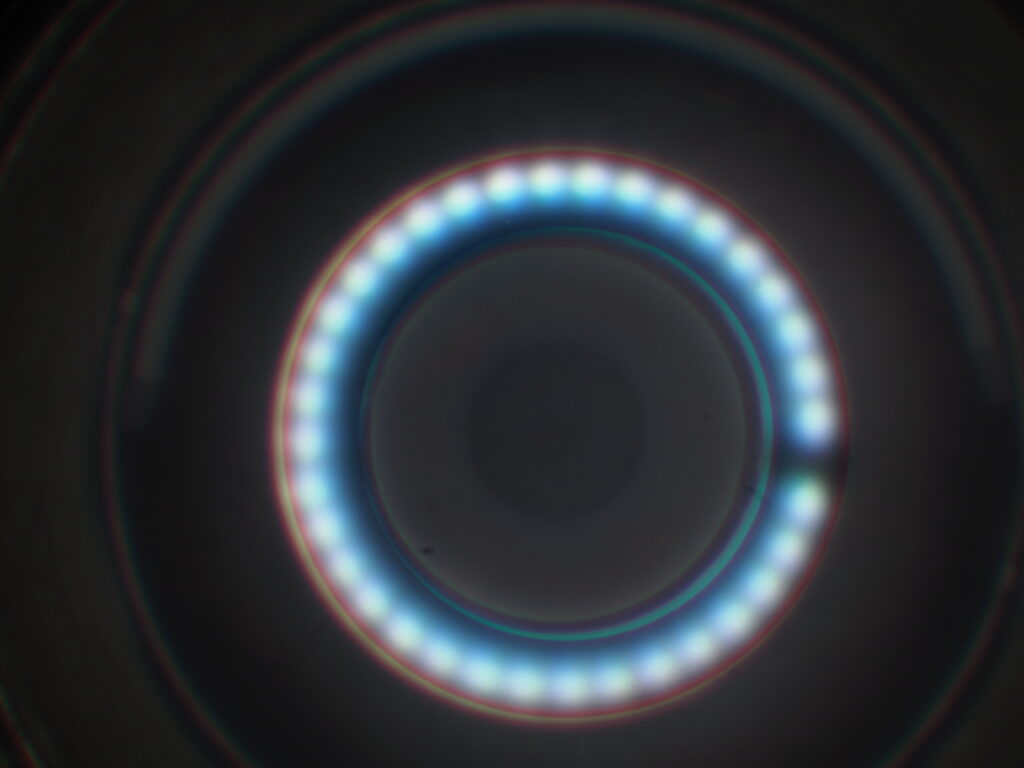
The outer ring (here set to ‘white’) aligns well to the PH3 phase ring in the 63X NA1.4 objective – this is a view through the OptoVar (phase telescope).
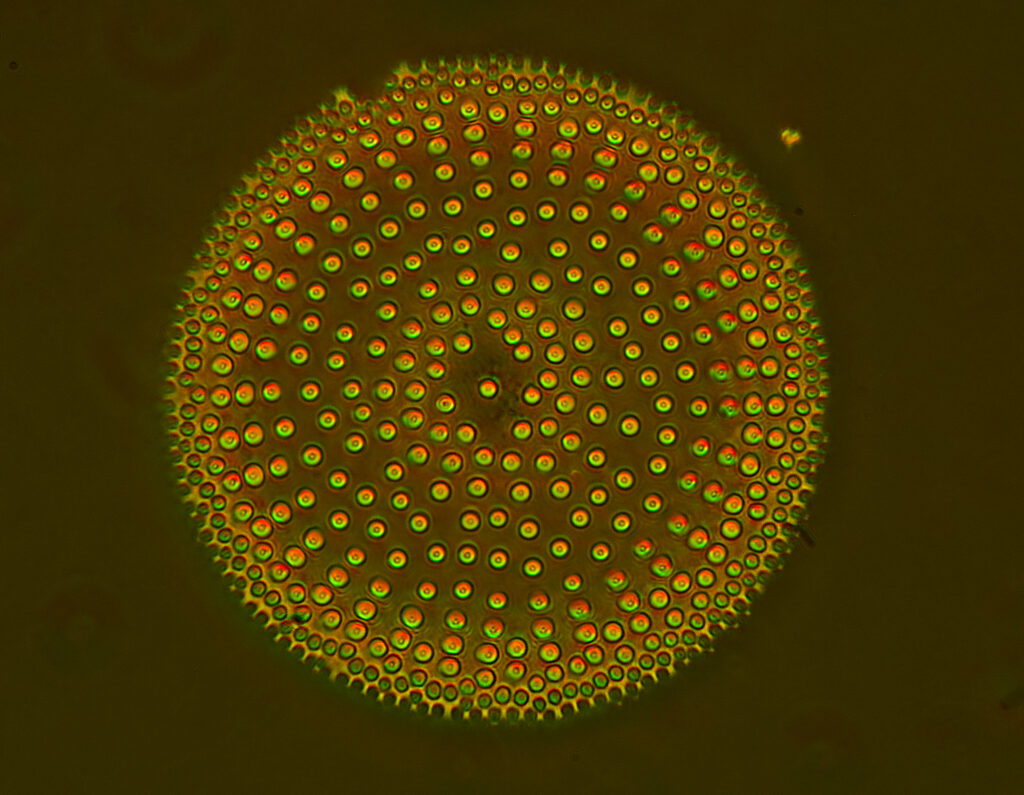
A diatom viewed using the PH3 63X lens with the outer LuciLED ring set to half red and half green. Stack of 12 images.
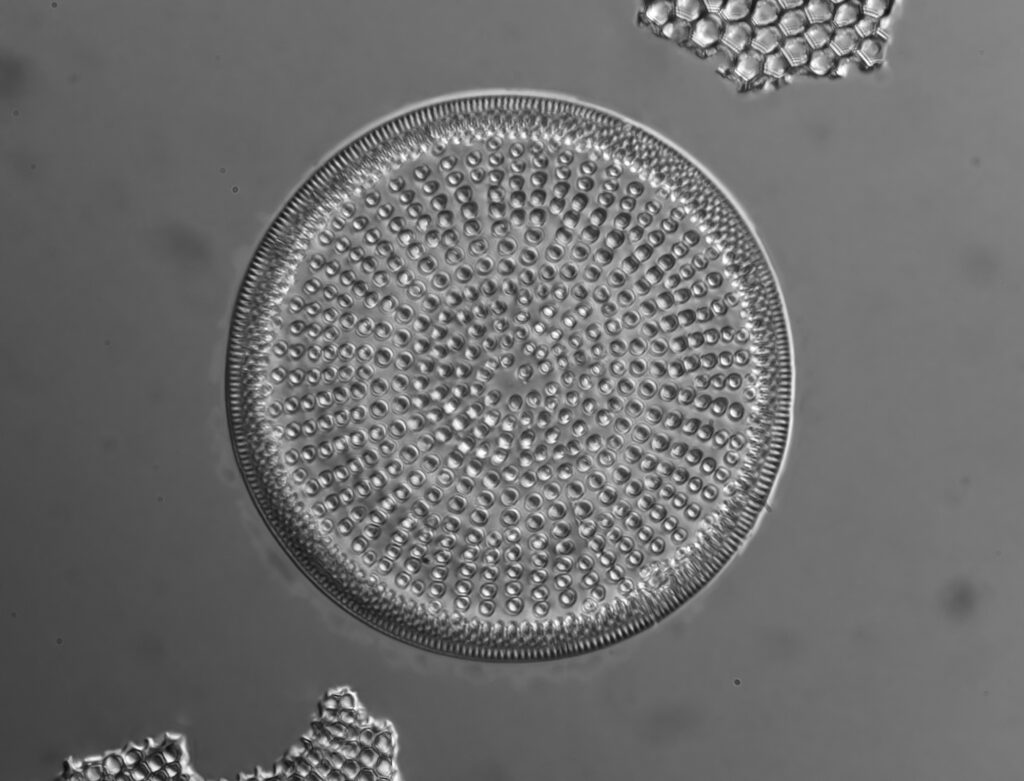
Same objective as above with the outer ring set to ‘white’ (R G and B all equal). Stack of 12 images converted to B&W.
Leave a Reply